
For the past 6 months, building production-ready voice AI meant writing unmaintainable 2,000+ token prompts. We built Agent Flows to change that.
At Osvi AI, we've built hundreds of voice agents for global businesses, from healthcare clinics managing millions of USD in annual revenue to trading platforms scaling their support operations. Every one of them started with a massive prompt that tried to be everything to everyone.
We're done with that approach.
The Problem with Monolithic Prompts
Let's say you're building a front desk agent for a clinic. Your prompt needs to handle:
- Appointment scheduling for 12 different doctors
- Insurance/TPA verification processes
- Billing and payment collection
- Pharmacy prescription orders
- Post-discharge follow-ups
- General inquiries about clinic timings and address
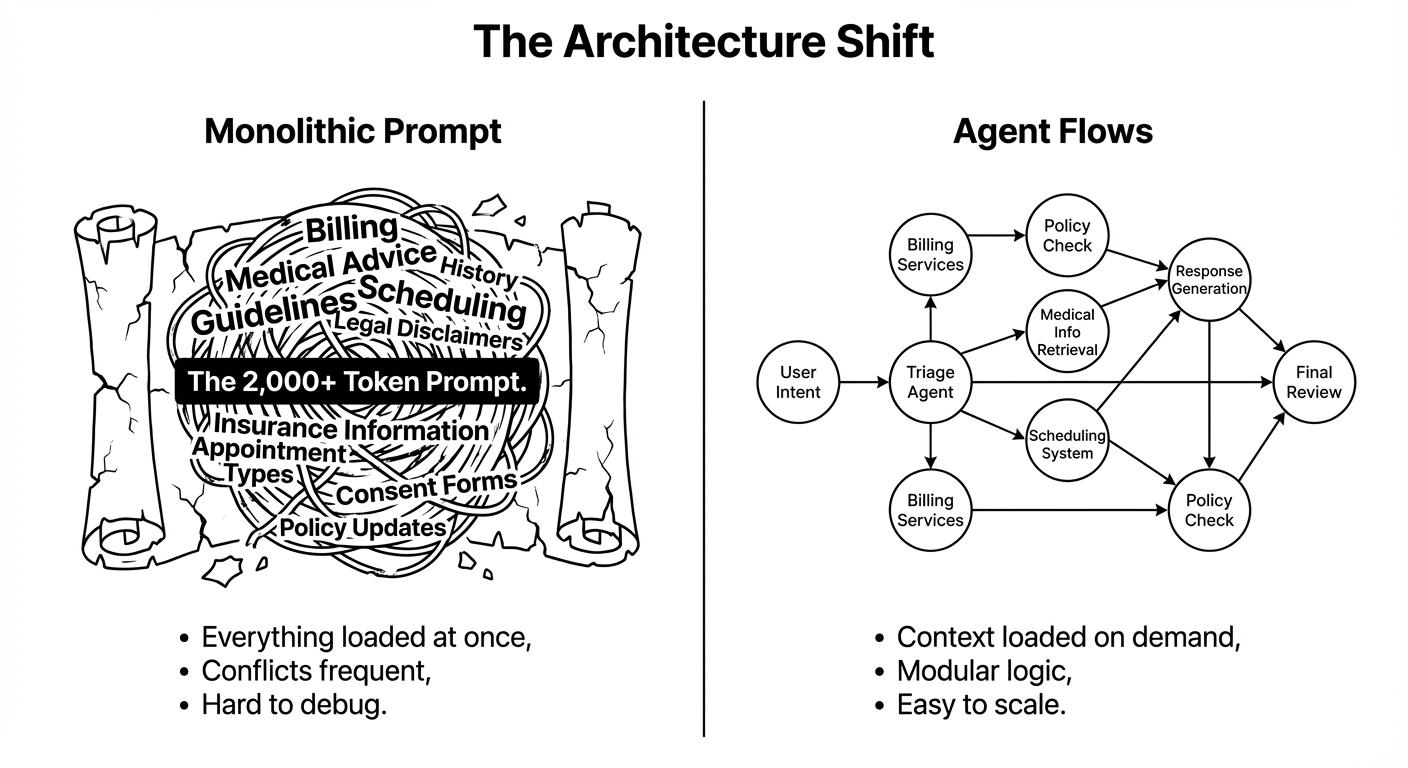
The traditional approach packs all of this into one giant prompt and passes it to the LLM on every turn of the conversation. That causes three problems.
1. Token Overhead Kills Latency
On every turn of the conversation, the model processes the entire prompt again, along with the growing chat history.
When a patient calls asking, "Which doctors are available tomorrow?", the LLM still gets every token of the billing process. That wastes tokens and adds 200-400ms of latency, because the model has to process irrelevant context.
In voice AI, latency is the difference between "this feels like talking to a person" and "this feels like talking to a machine."
2. Context Degradation at Scale
As conversations run past 8-10 minutes, agent performance degrades.
We've seen agents start hallucinating once context window usage crosses 70-80%. They forget what the caller said earlier in the call. A patient who mentioned their preferred doctor 5 minutes ago has to repeat themselves.
The LLM is processing that massive prompt plus the growing conversation history, and it gives older context less and less weight. The bigger your prompt, the sooner you hit this point.
3. Impossible to Debug and Iterate
When something goes wrong with a monolithic prompt, good luck figuring out which section caused the issue. Maybe the personality guidelines conflict with the edge case handling, or the billing instructions interfere with appointment scheduling.
You end up playing prompt whack-a-mole: fix one thing, break another. A change meant to improve TPA verification accidentally makes the agent too formal during general inquiries.
How Agent Flows Work
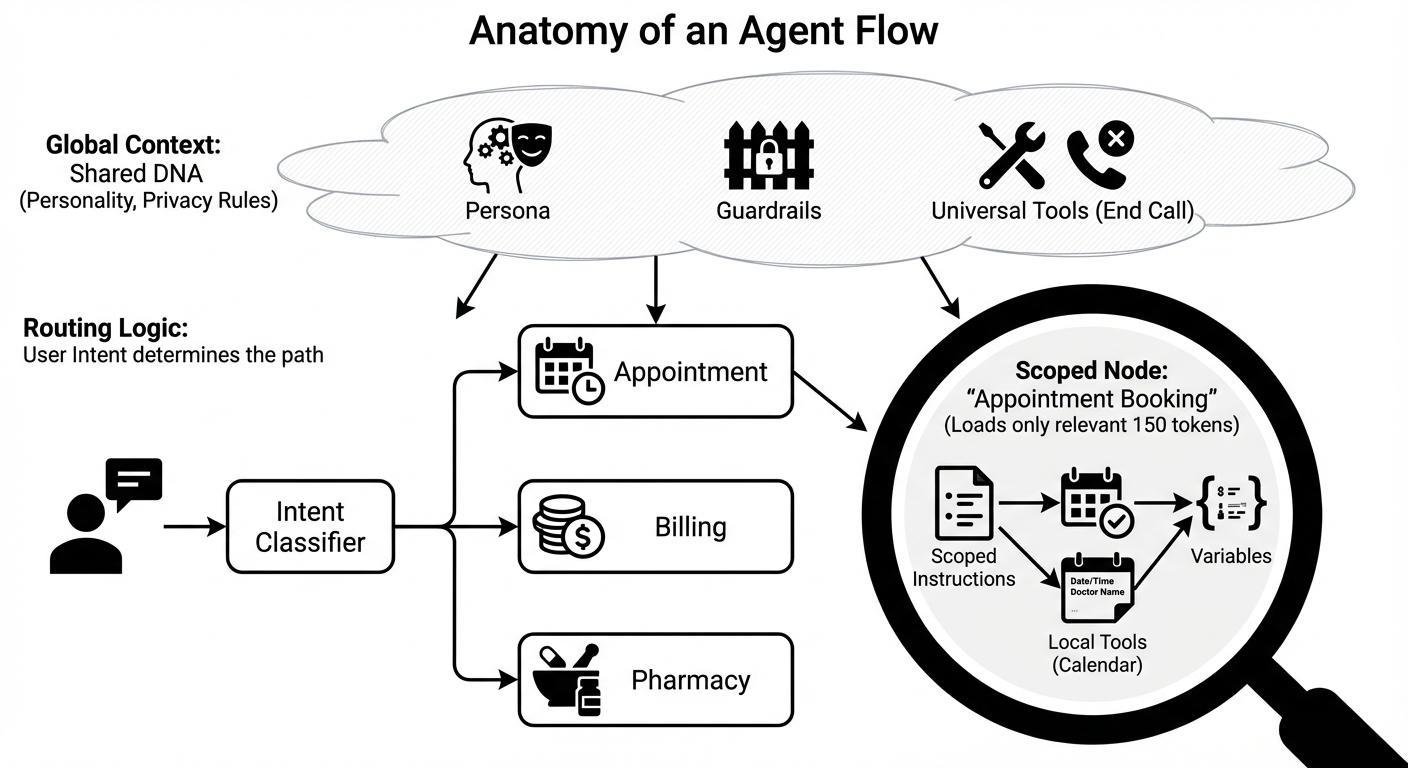
Agent Flows restructure the entire conversation as a directed graph of nodes and edges.
Global Layer: What Every Node Shares
You define global properties that apply throughout:
- Agent Objective: "You are a professional front desk agent for Dr. Sharma's Clinic"
- Personality Traits: Warm, patient, uses respectful language
- Guardrails: No medical advice, data privacy rules, always answer from knowledge base
- Universal Tools: end_call(), transfer_to_human(), send_voicemail()
This global context is lean, maybe 150-200 tokens instead of 2,000, depending on your use case.
Nodes: Scoped Intelligence
Each node covers one phase of the conversation and has:
- Scoped Instructions: Only what's needed for this specific task
- Node-Specific Tools: Only the functions relevant to this step
- Variables: Data that flows to subsequent nodes
Example node for appointment booking:
Instructions: "Help the patient schedule an appointment. Ask for preferred date,
doctor, and reason for visit. Check doctor availability using the calendar tool."

Tools: check_doctor_availability(), book_appointment(), get_patient_history()

Output Variables: appointment_date, doctor_name, visit_reason
That's maybe 100-150 tokens, versus the 2,000-token monolith.
Edges: Intelligent Routing
Edges define how the conversation flows between nodes based on:
- User Intent: "I want to pay my bill" → Routes to Billing Node
- Conditional Logic: If payment_amount > $10,000 → Route to manager approval
- Context State: If appointment_booked == true → Route to confirmation
The agent only loads the context it needs, when it needs it.
The Technical Advantages
Fewer Tokens per Turn
Instead of processing 2,000 tokens per turn, you're processing:
- 200-400 tokens (global context)
- 150 tokens (current node instructions)
- Growing chat history (unavoidable)
Real example from our healthcare client:
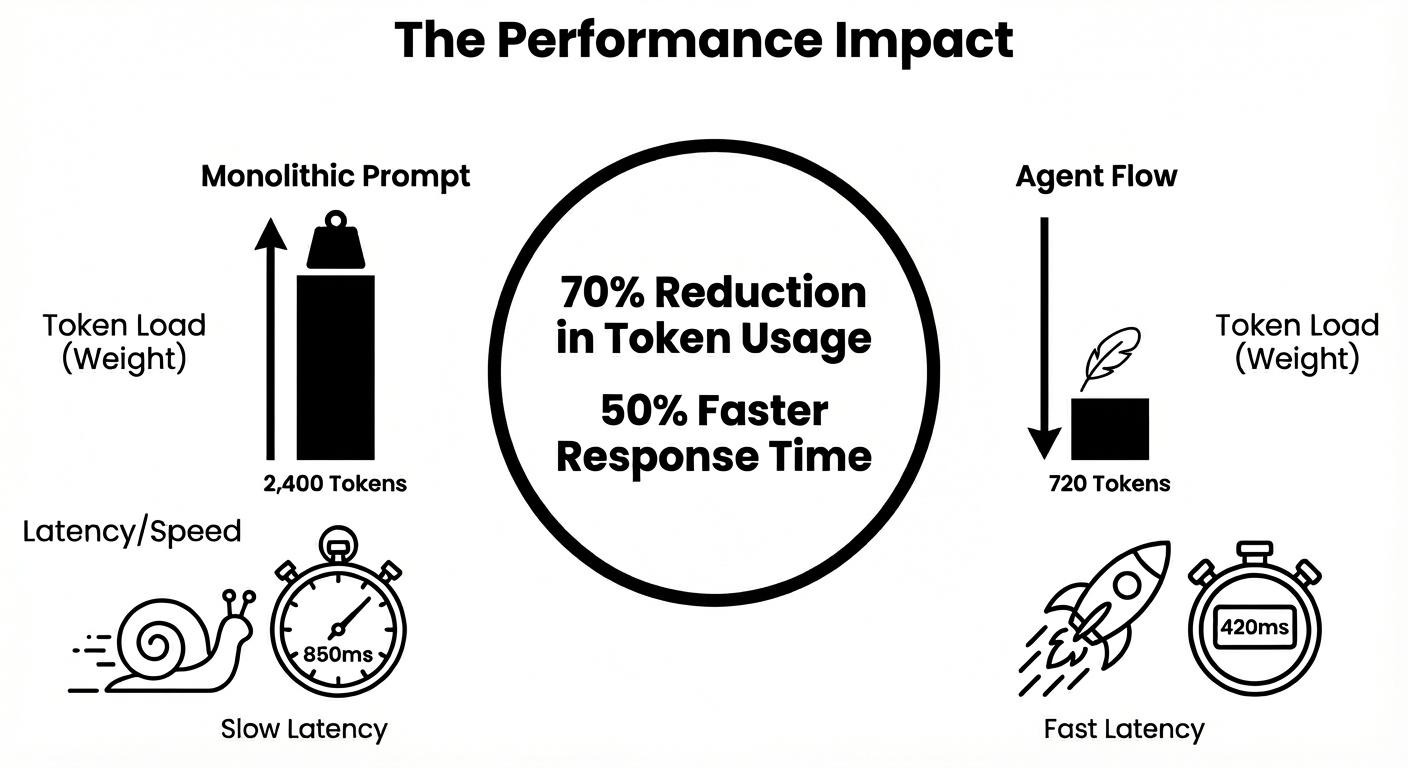
- Before Agent Flows: Average 2,400 tokens per turn → 850ms latency
- After Agent Flows: Average 720 tokens per turn → 420ms latency
That's a 70% reduction in tokens and a 50% reduction in latency.
Context Retention Through Variables
Instead of hoping the LLM remembers what the caller said 10 minutes ago, you explicitly pass critical data through variables:
Node 1 (Appointment Booking):
  Collects: patient_name, doctor_preference, appointment_date

Node 2 (Insurance Verification):
  Receives: patient_name, appointment_date
  Uses: "I see you have an appointment with Dr. Sharma on [appointment_date]"
Variables largely solve the context degradation problem, because you program state management explicitly instead of relying on the LLM's context window.
Controlled Conversation Flow
In a single-prompt agent, the LLM decides the entire conversation flow through probabilistic generation. Sometimes it works beautifully. Sometimes it goes off the rails in ways you can't predict.
With Agent Flows, you design the conversation architecture:
- Greeting → Intent Classification → Route to appropriate node
- Complete task → Offer related service or end call
- Error state → Escalate to human transfer
You keep the flexibility of conversational AI and add the reliability of deterministic routing.
Script Adherence Without Rigidity
Traditional IVR systems are rigidly scripted but feel robotic. Pure LLM agents are natural but unpredictable.
Agent Flows use each approach where it fits:
Within each node, the agent uses natural language to accomplish the task. It can handle variations in how users express intent, clarify ambiguities, and have natural back-and-forth.
Between nodes, the conversation follows explicit guardrails. The agent can't randomly jump from appointment booking to discussing billing without going through the proper routing logic.
The caller gets a conversation that feels natural and stays on track.
Who This Is For
Non-Technical Teams: You don't need to be a prompt engineering expert. Design the conversation flow visually, define what each step should accomplish, and let the system handle the complexity.
Developers Maintaining Complex Agents: Instead of a 3,000-token prompt with 47 nested conditional statements, you have a clear graph structure that's maintainable and debuggable.
Businesses Scaling Voice AI: When you need to add a new service or modify how something works, you update specific nodes instead of re-engineering the entire prompt.
Looking Ahead: Multi-Agent Orchestration
We're using Agent Flows as the foundation for multi-agent systems.
Your bank's helpline already works this way. You dial a general number, explain your issue, and get transferred to the credit card department, investment team, or loan specialist. Each specialist handles their own domain.
Next, we want each node to be its own specialized agent:
- Intake Agent: Understands your query, gathers context
- Billing Agent: Expert in payment processing and financial queries
- Support Agent: Handles technical troubleshooting
- Escalation Agent: Manages complex cases requiring human intervention
Each agent maintains its own knowledge base, tools, and optimization. The system orchestrates handoffs with full context transfer.
We'll handle the most complex use cases by letting specialized agents work together instead of making one agent do everything.
For Businesses Deploying Voice AI
Multilingual Complexity: Different nodes can have different language preferences. Your greeting might be in Hinglish, while billing can be more formal Hindi or English based on user preference.
Compliance Requirements: You can enforce industry-specific compliance rules at the flow level instead of burying them in prompt clauses.
Scalability with Control: As your business grows and use cases expand, you add nodes rather than bloating a single prompt.
At Osvi AI, we built this because we needed it. Our clients were hitting the walls of monolithic prompts, and we wanted modular, maintainable, high-performance voice AI that scales with business complexity.